More of the work only you can do.
- The board paper, argued from every side before you walk in
- Your network, searchable at the moment a name matters
- The taste that makes your work yours, written down and applied
Build one that does, and keep the edge.
An AI brain is a working system that holds your standards, your context and the decisions you have already made, then uses them on real work. Built with you in private, inside your own accounts.


Hours back every week, and better calls made with them.
You say which is the better one, and why. Real work, never a questionnaire.
In your words, with the two examples kept beside it as the evidence.
What holds is kept. What does not is rewritten, by you, and the record shows when.
Behind the brain sits CTRL, our own decision engine. It lays out a situation in plain English: the trade-offs, the arguments against, and what would change your mind.
We built this for ourselves first. Then we build yours.
What a company publishes about its own product counts for less than what it actually shipped.
One report is a rumour. Two that agree is something you can use.
If the answer depends on something only you know, it says so rather than guessing.
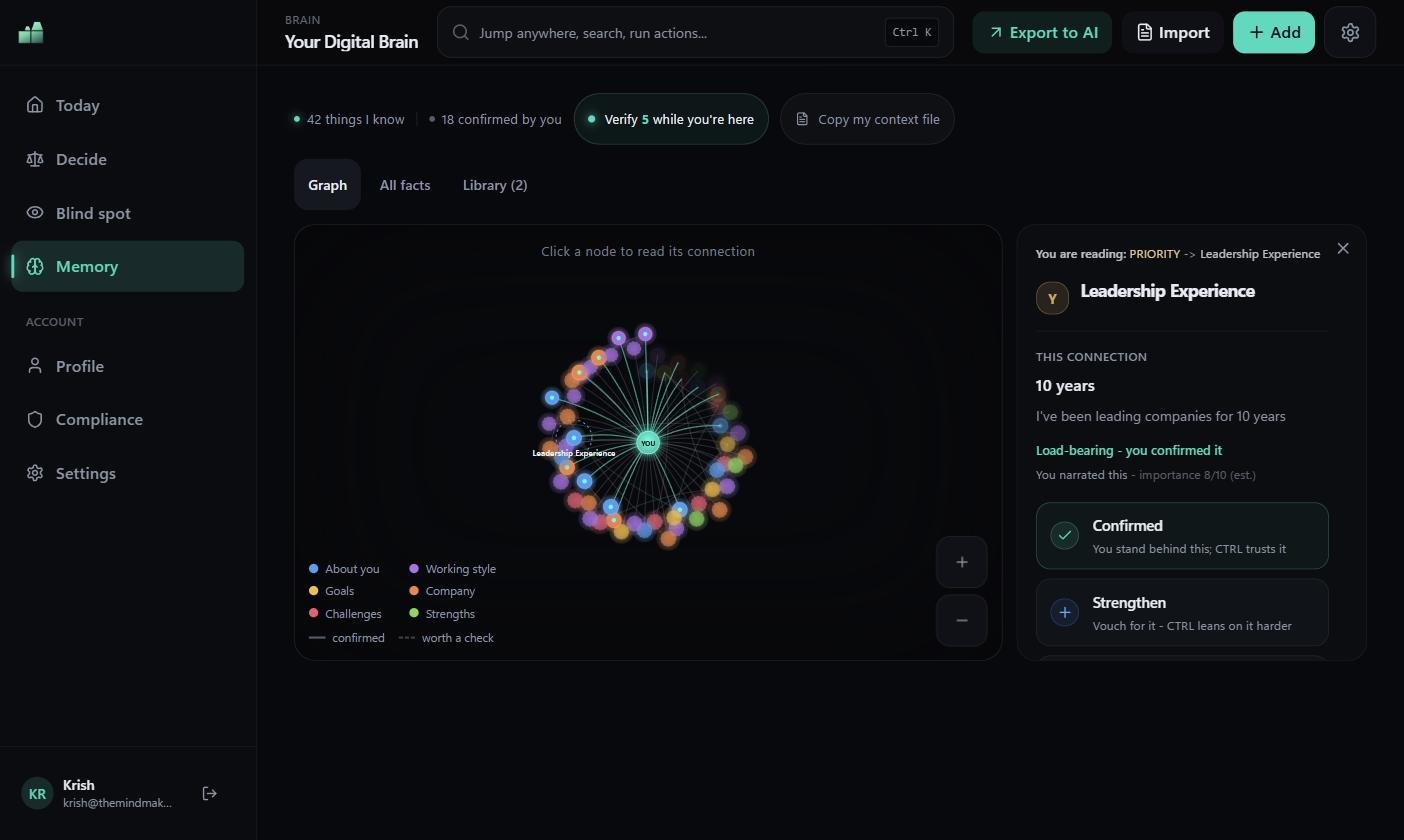
You confirm what is true and fix what is not.

We read your company from the outside, then what that means for your own week rather than for the business.
Built once, connected to where you already work.
We learn your standards from real work, switch on the parts that keep learning, and leave when it is running.
It gets better the more you use it.
Occasional check-ins to build the habits that keep it improving. No monthly retainer.
No. The work happens on your own decisions, with you, and nobody else in the business has to be told you started. Where the work needs your team, you decide when and how they come in.
No. That is rather the point. We handle the technical side, and everything the system shows you is in plain English.
Week one we learn how you decide, from real work rather than a questionnaire. Week two the first piece goes live and you use it. After that we connect it to the tools your week already runs on and tighten it against what you actually did with it. You see something working from the first week, not a plan at the end.
The system, the automations and the record of your standards. All of it is yours, and it keeps working after we finish.
Only you. We build it inside your own accounts, and we never publish, share or train anything on your work.
On the result, agreed before we start, and not on hours or a monthly retainer. We say what the work will produce, you agree the number privately, and it does not move afterwards. There is nothing to cancel at the end because there is nothing running.
You would know inside the first week rather than at the end, because something real is running by then. If it is clearly not going to be worth it we say so and stop, and you keep whatever has been built up to that point.
It will get things wrong, and so will the next one. What matters is what happens then. Writing, the loom, the calculator and satnav all drew the same objection when they first slipped, and the objection was rarely about accuracy. A system built inside your own accounts, that shows its sources and says when it cannot know, is one you can check rather than one you have to trust.
You could, and some people should. What usually stops it is not capability, it is that the work never reaches the top of anyone's week. We bring the time, the tooling and the pattern from having done it before, and we leave you owning it rather than depending on us.

Sixty seconds on the idea underneath all of this: machines do the remembering and the searching, and a person still makes the call.
How the digital world gets paid for, as attention, content and access change. Who pays, where the value moves, and what breaks when the shift lands.
The people using AI to go from running something to building something, and the real reason underneath the reason they give you.
You keep everything.
The system, the automations and the record of your standards.
